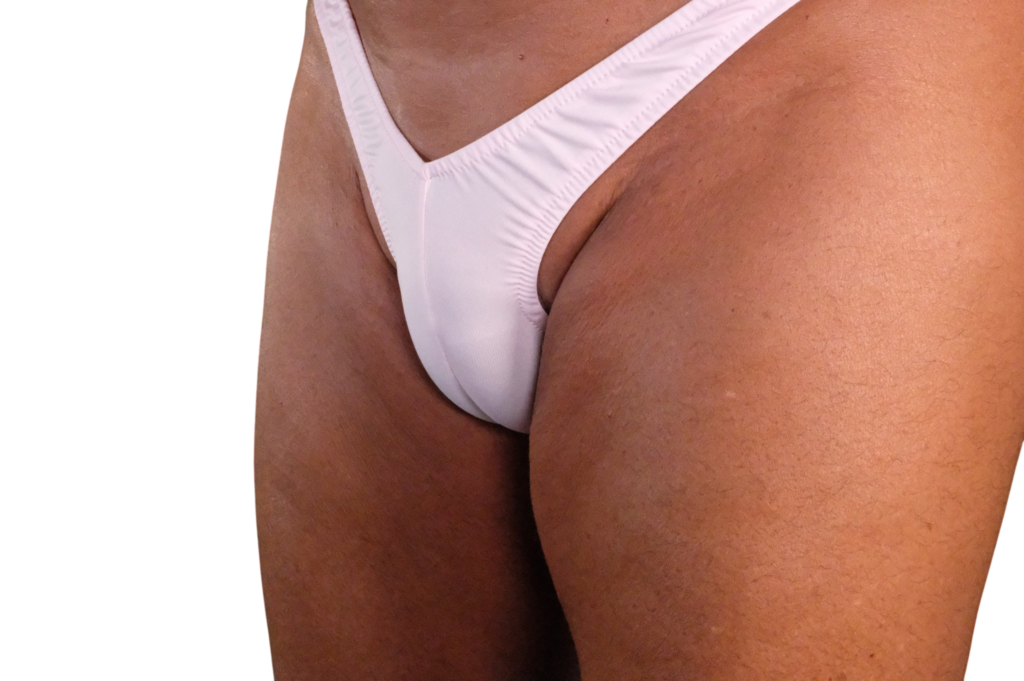
Gender Transformation at the Beach: MTF and Tucking Swimwear for a Feminine Silhouette
The beach can be one of the most exciting—and sometimes intimidating—places to experiment with gender presentation. Everyday clothing provides countless ways to change the body’s apparent shape, but a swimsuit leaves considerably less room to hide or reshape anything.
For transfeminine people, pre-op or non-op trans women, feminine men, gender-fluid people, crossdressers, and other adults exploring a feminine presentation, this creates an obvious question:
How can I create a convincingly feminine swimsuit silhouette when I still have male genital anatomy?
Modern MTF and tucking swimwear approaches provide several answers. Some focus on compression and smoothing. Others use specialized shaping panels, gaff-like construction, or feminine styling to visually minimize the genital area.
The objective for many wearers is straightforward: instead of a conventional masculine swimsuit bulge, they want the front of the swimsuit to appear smooth, flat, and feminine, with little or no visible indication of a penis.
Why the Beach Can Feel Different
Gender presentation can be relatively easy to control with everyday clothing.
A skirt provides room. Dresses can reshape the body’s overall silhouette. Layers can conceal areas that cause discomfort or self-consciousness.
Swimwear changes everything.
Spandex is thin, stretchy, and form-fitting. Whatever shape exists underneath it tends to influence the outside appearance.
Conventional men’s swimwear often makes this even more noticeable because many men’s bikinis and briefs intentionally contain anatomical pouches designed to accommodate or emphasize the genitals.
MTF swimwear takes almost the opposite approach.
Instead of asking, “How can we comfortably accommodate a masculine bulge?”
the design question becomes:
“How can we create a feminine front silhouette?”
That change in objective can completely transform the appearance of a swimsuit.
What Is MTF Swimwear?
MTF swimwear is a broad term for swimsuits designed around a male-to-female or transfeminine presentation.
These garments can include bikinis, one-piece swimsuits, swim briefs, thongs, and other cuts. What distinguishes them is usually the construction of the front.
Instead of a projecting male pouch, an MTF swimsuit may use:
- Firm compression
- A reinforced front panel
- Gaff-like internal construction
- Flattening or smoothing layers
- Strategic seams
- Wider coverage where needed
- Stretch fabrics engineered to hold anatomy securely
- Feminine bikini cuts that change the overall visual proportions
Different designs produce different results.
Some merely reduce the bulge.
Others are intended to create a substantially flatter appearance.
Tucking Swimwear
Tucking swimwear combines a swimsuit with some of the functions normally provided by a separate gaff.
The goal is to keep the anatomy positioned securely enough that an ordinary masculine outline isn’t visible through the swimsuit.
This can be especially useful at the beach because swimming creates challenges that ordinary clothing doesn’t.
The garment gets wet.
The fabric stretches.
You walk, sit, swim, bend, and climb out of the water.
A tuck that looks excellent while standing in front of a mirror also needs to remain comfortable and reasonably secure during actual activity.
That is why purpose-designed swimwear can be preferable to improvising with ordinary underwear underneath a swimsuit.
The Smooth-Front Look
For many wearers, the ultimate goal isn’t to create any particular anatomical detail.
It is simply smoothness.
Imagine the appearance of a conventional women’s bikini bottom: there is no prominent forward-projecting pouch.
A smoothing MTF swimsuit attempts to reproduce that general silhouette.
This can have an enormous effect on someone’s overall presentation because the eye no longer encounters one of the most obvious characteristics associated with conventional men’s swimwear.
Combined with a feminine bikini cut, the transformation can be surprisingly dramatic.
The Importance of the Bikini Cut
Removing the appearance of a bulge is only one part of creating a feminine swimsuit presentation.
The shape of the swimsuit itself matters enormously.
Traditional men’s swim briefs and women’s bikini bottoms can differ in leg openings, side width, waist placement, rear coverage, seam placement, and overall proportions.
A feminine-cut bottom can visually lengthen the legs and change the apparent proportions between the waist and hips.
High-leg designs can be particularly effective.
So can narrow-sided bikinis that visually emphasize the hips rather than the front.
The transformation therefore comes from the complete garment—not merely what’s happening underneath it.
One-Piece MTF Swimsuits
One-piece swimsuits provide another interesting option.
Because the eye sees the entire torso as a single design, a one-piece can create a stronger overall feminine impression than simply changing the genital silhouette.
Strategically designed suits can visually emphasize the waist, hips, chest, or legs.
Some wearers also feel more secure in a one-piece because the garment provides greater overall tension and support.
For someone nervous about wearing feminine swimwear publicly for the first time, that extra security can be reassuring.
Bikini MTF Swimwear
Bikinis offer a very different experience.
They can be unapologetically feminine.
A bikini bottom designed around a smooth front, combined with a coordinated top, immediately changes the visual language of the outfit.
Colors and prints provide another opportunity for personal expression.
Black can be understated and elegant.
Bright colors can make the transformation deliberately noticeable.
Pastels, florals, metallic fabrics, tie sides, high-cut legs, and other traditionally feminine styling elements can take the presentation much further.
There is no requirement that transfeminine swimwear be subtle.
Tucking Without Excessive Compression
A common mistake is assuming that flatter automatically means tighter.
It doesn’t.
A swimsuit should provide enough support to create the desired silhouette without causing pain, numbness, significant discoloration, or circulation problems.
More compression isn’t necessarily more effective.
Good garment engineering can often produce a better result than simply making a swimsuit extremely tight.
The objective should be secure shaping rather than painful compression.
If a tuck hurts, produces numbness, causes concerning changes in color or temperature, or cannot be released easily when necessary, it should be adjusted or stopped.
Fit Is Everything
Sizing becomes especially important with transformation swimwear.
Too loose and the garment may not provide enough control.
Too tight and it can become uncomfortable or unsafe.
Measurements should therefore be taken according to the manufacturer’s sizing system rather than simply assuming that a person’s usual men’s underwear size will translate directly to specialized MTF swimwear.
Different fabrics also behave differently.
Some stretch dramatically.
Others provide much firmer compression.
And wet fabric can behave differently from dry fabric.
Test Your Swimsuit Before the Beach
A new MTF or tucking swimsuit shouldn’t ideally receive its first serious test after arriving at a crowded beach.
Try it privately first.
Walk around.
Sit down.
Stand up.
Bend over.
Move your legs.
If possible, test it in water.
Then examine the fit again after it becomes wet.
A swimsuit that looks perfect when dry may stretch or become more revealing when saturated.
This is particularly important with light-colored and thin fabrics.
Eliminating the Masculine Swimsuit Pouch
One reason specialized MTF designs can make such a difference is that they abandon the traditional men’s pouch.
Many conventional men’s bikinis are deliberately engineered to display anatomy.
Contoured pouches project outward.
Anatomical pouches follow the body’s shape.
Enhancing designs can make the front appear even more prominent.
None of that is desirable when the objective is a feminine silhouette.
MTF swimwear reverses the engineering priorities.
Projection becomes compression.
Emphasis becomes minimization.
The garment is trying to make the front visually blend into the overall swimsuit rather than become its focal point.
Gender-Fluid Swimwear
Not everyone using these designs identifies as a woman.
That’s important.
A feminine man might enjoy looking female at the beach without wanting to medically transition.
A gender-fluid person may alternate between masculine and feminine presentations.
A nonbinary person may prefer an intentionally ambiguous silhouette.
A crossdresser may simply enjoy occasional feminine presentation.
And a transfeminine person may consider the same garment an important part of living publicly as a woman.
The swimsuit doesn’t determine the wearer’s identity.
It is simply a tool for presenting the body in a particular way.
Pre-Op and Non-Op Trans Women
For pre-op and non-op trans women, specialized swimwear can be especially valuable because surgery isn’t a prerequisite for presenting femininely at the beach.
Some trans women plan gender-affirming surgery.
Others don’t.
Some are undecided.
A person’s current anatomy doesn’t prevent them from wearing a swimsuit that supports their gender presentation.
A well-designed tucking or smoothing swimsuit can make a major difference in confidence precisely because it reduces the need to worry constantly about whether a conventional male outline is visible.
Creating the Complete Feminine Beach Look
A feminine swimsuit silhouette isn’t determined by one body part.
The entire presentation contributes.
Swimsuit cut, hairstyle, accessories, posture, grooming, cover-ups, sandals, sunglasses, jewelry, and personal style can all contribute to how someone feels and presents.
That means someone doesn’t necessarily need an absolutely perfect tuck to create a strongly feminine appearance.
People perceive the whole person.
A flattering bikini with a smooth front can simply become one component of that larger presentation.
From Private Experiment to Public Beach
For someone experimenting with gender transformation, wearing a feminine swimsuit privately and wearing one publicly can feel like two completely different experiences.
The first public outing may produce a tremendous amount of self-consciousness.
That is normal when trying any dramatically different form of clothing.
Choosing an accepting environment can help.
Some people begin at a private pool.
Others choose an LGBTQ+-friendly resort or beach.
Some first wear their swimsuit while traveling, where the anonymity makes experimentation feel easier.
Eventually the unusual can become ordinary.
You stop thinking constantly about what you’re wearing and start doing what everyone else came to do:
Swim.
Relax.
Walk along the beach.
Enjoy the sun.
The Psychological Importance of Seeing Yourself Differently
Transformation swimwear isn’t only about what strangers see.
Sometimes the most meaningful reaction comes from looking in the mirror.
Someone who has spent years seeing a masculine swimsuit silhouette may suddenly see something dramatically different:
A feminine bikini.
Feminine proportions.
A smooth front.
No obvious masculine pouch.
For a person exploring femininity or experiencing gender dysphoria, that visual change can carry considerable emotional significance.
Clothing cannot change anatomy permanently, but it can change presentation immediately.
And sometimes that temporary transformation provides useful information about how someone wants to present more broadly.
It Doesn’t Have to Be About Transition
At the same time, enjoying MTF swimwear doesn’t automatically mean someone is transgender or should transition.
A man can enjoy feminine swimwear and remain a man.
A femboy can enjoy an extremely feminine beach presentation.
A crossdresser can enjoy occasionally presenting as female.
A gender-fluid person can move between presentations.
A trans woman can use exactly the same clothing as part of affirming her everyday gender.
Similar clothing can have completely different meanings for different people.
The Beach as a Place for Gender Expression
Beaches have always been places where fashion becomes more adventurous.
Men who normally wear conservative clothing may appear in tiny swim briefs.
Women experiment with cuts and styles they wouldn’t wear elsewhere.
People show more of their bodies and often become more playful with color, fashion, and presentation.
That makes the beach a natural place for gender experimentation as well.
MTF and tucking swimwear expand the possibilities considerably.
A person who once thought, “I could never wear a women’s bikini because everyone would immediately see that I have male anatomy,” now has considerably more specialized garment options available.
A Swimsuit Can Change the Silhouette Without Changing the Body
This is ultimately what makes transformation swimwear so interesting.
The body underneath hasn’t magically changed.
The presentation has.
Specialized construction, compression, tucking, smoothing, and feminine swimsuit cuts can dramatically reduce a conventional masculine genital outline and create a much more traditionally feminine silhouette.
For some wearers, that is simply fashion.
For others, it is experimentation.
For others, it provides gender affirmation.
And for some, putting on that swimsuit and seeing a feminine reflection can be an important step toward understanding themselves.
Gender Transformation at the Beach
There is no single correct way to look feminine at the beach.
Some people want a subtle gender-neutral appearance.
Others want an unmistakably feminine bikini.
Some want a completely smooth front.
Some use tucking swimwear only occasionally, while others consider it essential beachwear.
The important development is that having male genital anatomy no longer means someone must automatically accept the traditional appearance of men’s swimwear.
MTF swimsuits, tucking designs, gaff-style construction, compression panels, and feminine bikini cuts provide alternatives.
They can minimize the masculine bulge, create a smooth front, and allow the overall swimsuit—not the wearer’s anatomy—to define the presentation.
For someone who wants to walk onto the beach presenting as feminine, that can provide something much more important than simply a different swimsuit.
It can provide the freedom to look in the mirror and see a beach presentation that feels like their own.